The Pantanal Revisited
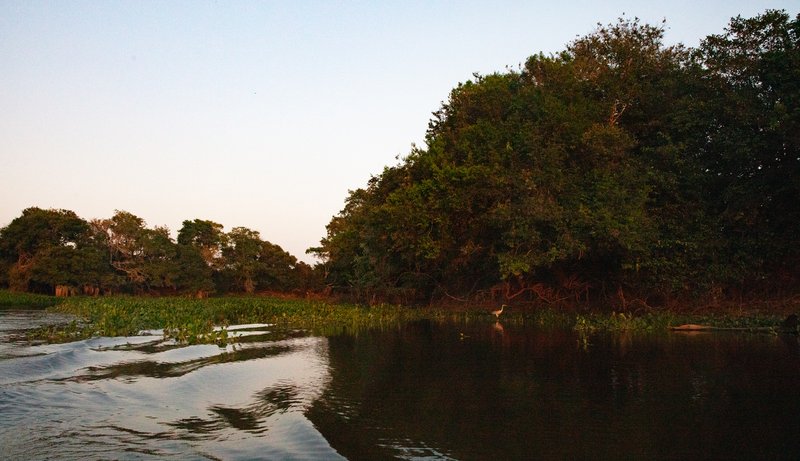
Sunrise Departure, Cuiaba River, Porto Jofre, Poconé, State of Mato Grosso, Brazil
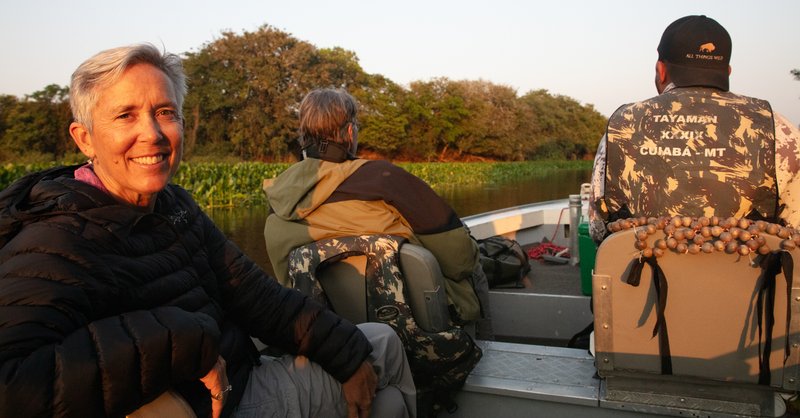
The tour included five morning and five afternoon boat trips on the Cuiaba River in search of jaguars and other wildlife. Our group had three boats. Mark, a driver and two guests in one, a driver, Beto, and three guests in the second and a driver, Paulo and three guests in the third, so two boats with four people and one boat with five people. The boat with five people was, logically, the most difficult to photograph from. None of the drivers spoke English, so Paulo’s boat was the only one with a translator.
Boats were pre-assigned depending on the number of couples who wished to stay together (not encouraged) and the number of singles and split couples who could be placed with such couples. Out of the five mornings on the river, we spent three with Paulo, two with Mark and none with Beto. Since we went out for 5-6 hours in the morning and three in the afternoon, we spent about 18 hours on the river with Paulo, 13 with Mark and only nine with Beto, so we had five people in the boat almost half the time.
The river works much like a traditional African safari in Kenya or Tanzania, in that drivers all have radios and within minutes of any easily accessible jaguar sighting, more than 20 motor boats will show up, all jockeying for the best position. There are rules about moving in front of boats that arrived before you and standing in the boat if there are boats behind you. They are well-intentioned and usually adhered to.
Since the main portions of the river have a current, boats will sometimes anchor and drift into position if a jaguar is resting along the shoreline. For some inexplicable reason, they do not have a float attached to the anchor rope and cannot quickly detach the anchor rope from the boat clete if the jaguar moves. We had one instance, in Paulo’s boat, where a jaguar rose quickly, turned and leapt into the water onto a caiman just out of our view. Beto’s boat quickly moved into position and guests got to watch the kill and the jaguar being dragged up the bank, while we sat there, anchored. My request to move the boat was ignored and I quickly became the least popular guest on the trip. Mark’s boat was anchored next to us and we also could have quickly untied the anchor and had him hold the rope. We could have also taken his two passengers. When I work with my own boat and driver, it is understood that the driver’s main job is to put me into position to make the best photographs. That was not the case with this group, although the drivers were all professional and only doing what they were told.
The evening before our first boat ride to photograph jaguars, we went to a lecture by Abigail Martin, an American zoologist who created the Jaguar Identification Project in 2015 and founded the non-profit The Wetland Research Center, Inc in 2020. The Jaguar ID Project uses citizen science and remote camera traps to study the ecology and behavior of the jaguars found in the Porto Jofre and surrounding region of the Brazilian Pantanal. Over the past decade she has documented nearly 300 different jaguars and has over 5,000 hours of wild jaguar observations. Her project boasts the largest database of jaguar demographics in the wild and has given an immense amount of value to the jaguars in the only place in the world where an alive jaguar is worth far more than a dead one. She also publishes a guide book to the most commonly observed jaguars. Every jaguar has a different pattern of spots, so they can be identified from photographs.
We left each morning between 5:30-5:45 a.m. depending on who was on the boat. The boats also had different morning agendas. Paulo’s boat always went birding, as that is his primary focus and area of expertise. He carries a library of bird calls on his iPhone and a speaker and we spent hours listening to him play bird calls, hoping to call in birds or elicit behaviors in shady forests from birds far out of range for photography. Although interesting, this was not a productive use of time on a photography tour. Mark’s boat would go looking for good photographs, no matter the subject and this was almost always a good use of the best morning light. We were never on Beto’s boat in the morning, so I’m not sure where he headed, although he was excellent when we were with him in the afternoon.
The Pantanal, Brazil
It had been almost 14 years since my first trip to the Pantanal, so I had plenty of time to plan. It is a vast area and not an easy place to visit unless you go with an organized group. A boat is required and the primary habitat is at the end of the poorly maintained Transpantaneira, a 91-mile long dirt road, which runs from Poconé to Porto Jofre, Brazil. The road includes 122 wooden bridges, perhaps one less after our van was impaled by a large wooden cross beam from one on the drive south.
In December 2009, I was in Brazil for the wedding of a friend who had left UNC-CH shortly after I did and gone back to work in the industry. Later, he would join me at the University of Miami. None of that is relevant other than to explain why I was in Brazil and why I decided to stay an extra week and try to photograph jaguars in the Pantanal, a vast wilderness that encompasses the world's largest tropical wetland and the world’s largest flooded grassland. It is habitat for the largest jaguar population on Earth.
The wedding was lovely and the next day, we flew to Cuiaba, about a two-hour direct flight from São Paulo. Somehow, TAM Airlines managed to lose my luggage on the two-hour direct flight. That included my tripods, remotes, beanbags and numerous other photography accessories that I could not manage to fit in my carry-on allowance, as well as my clothes. We met our guide and he suggested we have lunch nearby and wait for the next flight. We did, but still no luggage and no information or tracking. We had a long drive ahead of us, so against my better judgment, we left Cuiaba.
At lunch, our guide had informed us that much of the Pantanal was flooded, that we would not be able to see jaguars and that many of our accommodations had been changed. He could not explain to me why I was not informed of this prior to our departure, why we were not given the option to reschedule or cancel or even where we would be going. Nevertheless, off we went.
We spent a week driving around the open parts of the road with only one day on the water. For most of that time, the vehicle was not suitable for photography. The guide had not been informed that I was a photographer. I finally saw my duffel bag five days later, a day before it was time to fly back to São Paulo and connect to Iguassu. I should have spent more quality time with it, because it did not arrive in Iguassu with us, or ever. The next time I saw it was two weeks later, when TAM Airlines returned it to the airport in Miami, without any explanation and certainly without an apology or any compensation. TAM Airlines no longer exists, merging with LAN to form the LATAM Airlines Group (that filed for bankruptcy in May 2020). I wish I could take some credit for their downfall, but I can’t.
My dream of returning to the Pantanal almost went up in smoke, when in 2020 more than a quarter of the Pantanal burned while former President Bolsonaro’s government did little to stop the wildfires. The Associated Press quoted Daniel Moura, who owns an eco-tourism company in the area, “We used to see jaguars here all the time; I once saw 16 jaguars in a single day,” he said while on the riverbank in Encontro das Aguas State Park, which had 84% of its vegetation destroyed.
Of course, it should not surprise anyone that in 2022, our President, the Orange Idiot, endorsing Bolsonaro’s re-election bid, wrote on his social media site, “‘Tropical Trump’ as he is affectionately called, has done a GREAT job for the wonderful people of Brazil.” Fortunately, neither Trump nor Bolsonaro are still in power and the jaguar population has begun to recover.
After talking to several photographers and friends, I selected a small group photo trip that offered five full days on the Cuiaba River looking for jaguars. Most trips offer only four. The trip also included a few other stops that were advertised as prime birding locations including a couple of days at Pousada Rio Claro in Poconé, Mato Grosso.